
An ADU short-term rental in Los Angeles is allowed only in certain circumstances. In the City of Los Angeles, hosting generally requires Home-Sharing registration, and the ADU must qualify as your primary residence. The city defines a short-term rental as lodging for 30 consecutive days or less. For ADUs whose building-permit application and plan-check fees were submitted on or after January 1, 2017, the city also requires a LADBS-issued Certificate of Occupancy identifying the structure as an ADU. You must live in your primary residence for more than six months of the calendar year, and regular Home-Sharing registration allows up to 120 rental days annually. These requirements make your ADU’s legal status and living arrangements central to the Los Angeles City Home-Sharing rules.
The answer can change when you cross a city boundary. Los Angeles County’s 2026 ADU guide says ADUs and JADUs there cannot be used for short-term rentals and must be rented for more than 30 days. Your property’s location matters before you plan around nightly bookings. Los Angeles County’s ADU guide is one reason to check the parcel’s jurisdiction and the unit’s permitted use before relying on vacation-rental income to support a design or construction budget.
Key Takeaways
- Your parcel’s jurisdiction determines which rental rules apply, so verify the ADU’s approved use before budgeting income from stays of 30 days or less.
- Regular Los Angeles Home-Sharing registration limits eligible ADU hosting to 120 days annually, making extended registration a separate pathway to investigate.
- Use Los Angeles-wide rental averages as one input when comparing projected net income after taxes and operating costs.
- All County Development reports 90+ successful projects, offering coordinated ADU support from design through construction.
Can You Airbnb an ADU in Los Angeles?
Sometimes, but not automatically. An ADU can be used for short-term hosting only if its jurisdiction, legal status, and local rules allow it. A building permit by itself does not establish that the unit qualifies for vacation rentals. In the City of Los Angeles, short-term lodging means a stay of 30 consecutive days or less. Rules can differ in unincorporated Los Angeles County and separate cities.
Start by confirming the exact parcel location. Then check whether the ADU’s approved status and permitted use allow your rental plan. California’s ADU Handbook says local agencies may require rental terms longer than 30 days, and ADUs created under Government Code section 66323 must be rented for terms longer than 30 days.
Separate cities show why a broad “Los Angeles” answer can be misleading. Beverly Hills prohibits short-term rentals in residential units, including ADUs, and requires residential leases to begin with a term of at least 12 consecutive months. Santa Monica’s ADU guide says short-term rentals are not permitted for ADUs on single-unit dwelling parcels.
Once you know the parcel’s jurisdiction and the unit’s permitted use, check the applicable registration and tax requirements. Then assess whether short-term hosting makes financial sense. If you build a design or construction budget around nightly rental income before confirming eligibility, your business plan may rely on an assumption the local rules do not support.
Which Rules Apply to Your ADU?
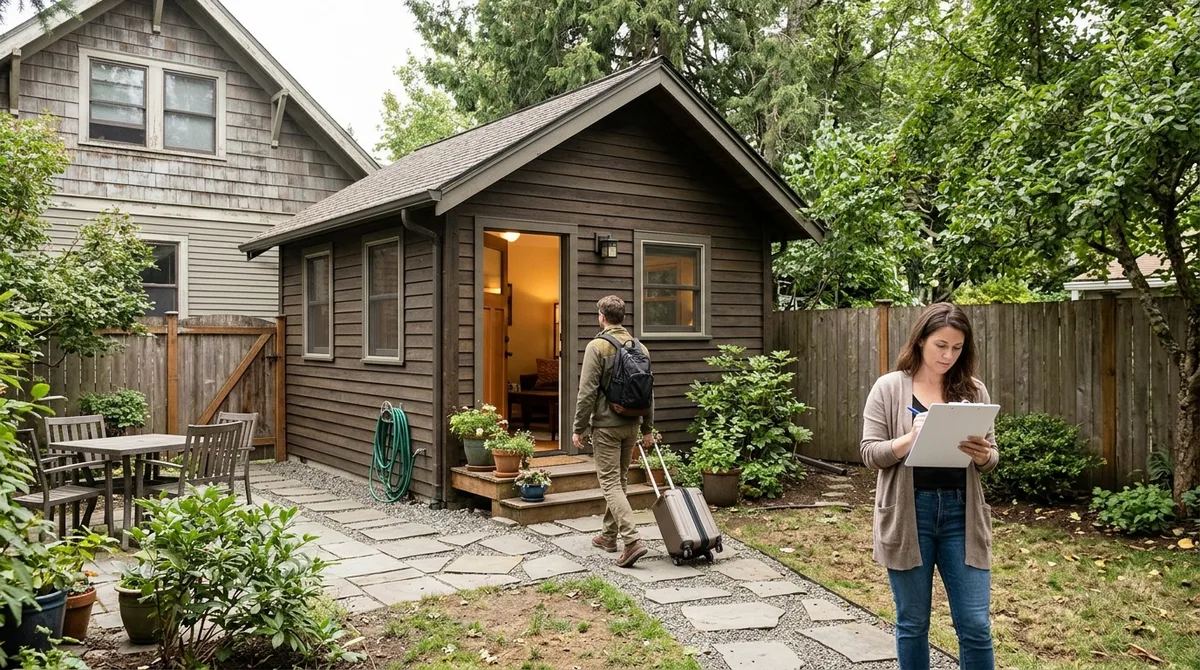
The rules that govern an ADU short-term rental depend on whether your parcel is in the City of Los Angeles, unincorporated Los Angeles County, or a separate city, as well as the unit’s legal status and approved use. A street address that says “Los Angeles” does not identify which authority’s rental rules apply. Confirm the parcel’s jurisdiction before using a city or county rule to plan a rental.
In unincorporated Los Angeles County, ADUs, junior ADUs, and units created through SB 9 cannot be used as short-term rentals and must be rented for terms longer than 30 days. The state rule does not make every ADU eligible for short stays. Local restrictions still matter.
Separate cities can set different limits. In Beverly Hills, violations can draw administrative fines of up to $5,000 per day. A neighboring city’s rules may not apply to your parcel.
A permitted ADU is not automatically a short-term rental. Zoning approval and a building permit address aspects of where and how a unit can be built, but they do not establish that nightly or vacation hosting is an allowed use. The unit’s permit history and legally approved use matter, as does the rental-term rule that applies to the parcel.
Before committing to a short-term-rental build plan, verify four things with the authority for the property’s address: the parcel’s jurisdiction, its zoning, its eligibility for an ADU, and the unit’s permit history and legally approved use. Ask specifically whether the proposed rental term is allowed for that unit and parcel. A plan based on guest stays of 30 days or less will not work where the applicable rule requires a longer rental term or prohibits short-term hosting.
Research the parcel and unit together. A rule that applies to a city or county does not tell you whether a particular structure was approved as an ADU or whether its permitted use supports your rental plan. Confirming both before making design decisions lets you assess your hosting plans against the rules that govern the property, rather than relying on a general “Los Angeles” assumption.
What Does LA Home-Sharing Require?
For an ADU in the City of Los Angeles, short-term hosting requires Home-Sharing registration, and the unit must meet the city’s eligibility requirements. A building permit alone is not enough. For an ADU whose building-permit application and plan-check fees were submitted on or after January 1, 2017, registration requires a Certificate of Occupancy issued by the Los Angeles Department of Building and Safety (LADBS) that identifies the structure as an ADU, as Los Angeles City Planning explains.
The Certificate of Occupancy and Home-Sharing registration serve different purposes. The certificate documents the unit’s approved status as an ADU, while registration is required to host under the city’s Home-Sharing rules. Having the certificate does not itself authorize short-term rentals, and registration does not make an otherwise ineligible ADU eligible.
The primary-residence test applies to the specific dwelling unit, not just the parcel. You must live in your primary residence for more than six months of the calendar year. If your property has multiple dwelling units, your primary residence is the particular unit you physically occupy. An ADU occupied by guests while you live in the main house does not automatically qualify as your primary residence.
Regular Home-Sharing registration permits up to 120 rental days per calendar year. Extended registration may allow more rental days, but you must first have held regular registration for six months or hosted for at least 60 days to apply. The extended option is a separate registration pathway, not a way to bypass the ADU’s eligibility or other rental restrictions.
For fiscal year 2026–2027, the city lists application fees of $441 for regular registration, $883 for an extended ministerial application, and $12,798 for an extended discretionary application. The fee depends on the registration type you pursue. Paying an application fee does not guarantee that your ADU qualifies or that an extended application will be approved.
Before including short-term income in your project plan, match the ADU’s permit documentation to the registration requirements and confirm that the unit you intend to host from can legally be your primary residence. Keep the rental-day limit and the distinction between regular and extended registration in mind when estimating how often the unit could be booked. Registration permits you to host only if the property and unit meet the other applicable rules.
What Will Hosting Actually Cost?
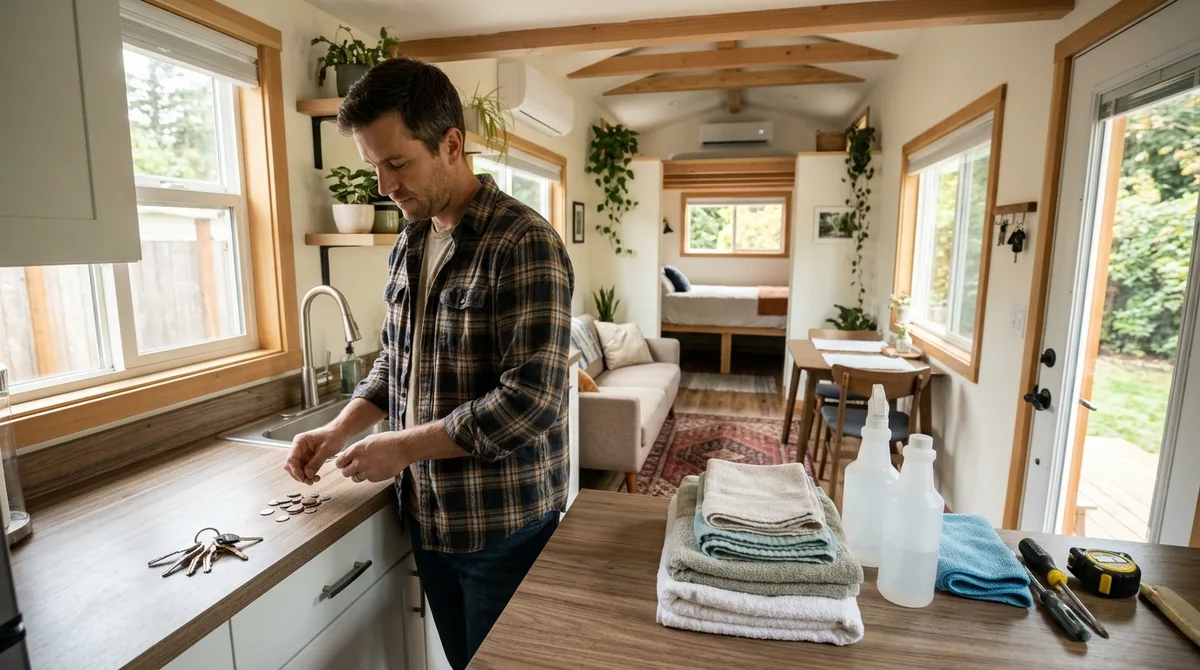
Hosting costs include one-time design, permitting, construction, and furnishing expenses, along with recurring operating costs, applicable registration fees, taxes, insurance, utilities, maintenance, cleaning, and replacement supplies. Your total depends on the property, project scope, and whether short-term use is legally allowed.
Start with a project-specific construction budget based on the parcel, existing structures, utility needs, desired layout, and finish level. Design and permitting are part of the investment, along with construction. Furnishing the ADU for guest use adds another one-time expense. Different site conditions or utility needs may require a different scope, so a generic ADU price cannot reliably represent your project.
After construction, budget for the ongoing work of hosting. Insurance, utilities, routine maintenance, cleaning between stays, and replacing guest-use items such as linens and kitchen supplies can all affect operating costs. Booking frequency and the unit’s features influence how much cleaning, upkeep, and replenishment it needs. Compare these expenses with expected rental income instead of focusing on the nightly rate alone.
Registration and taxes also depend on the parcel’s jurisdiction. In unincorporated Los Angeles County, short-term-rental hosts must obtain a Short-Term Rental Registration Certificate before renting. In the City of Los Angeles, include the applicable Home-Sharing registration fee in your budget. The fee varies by registration type.
For transient lodging in unincorporated County areas, the transient occupancy tax is 12% of rent. Hosts, not online hosting platforms, must collect and remit the tax within 30 days after the rental start date, as described in the County’s transient occupancy tax guidance. Budget for this tax as an operating obligation, not as income available to cover construction or other expenses.
County registration and tax steps do not make an ADU eligible for short-term use where County ADU rules prohibit it. Treat legal eligibility as a prerequisite to the financial calculation, then assess the full cost picture: project development, furnishing, compliance, and ongoing hosting. A plan based on nightly revenue alone can overlook expenses that affect the rental’s actual financial performance.
Can Short-Term Hosting Outearn Long-Term Rent?
Short-term hosting can out-earn a long-term rental in some cases, but neither strategy guarantees a higher return. As of October 2026, Los Angeles had 28,910 active short-term-rental listings, with 68% average occupancy, a $221 average daily rate, and $49,100 average revenue per listing over the trailing 12 months. These figures describe the citywide short-term-rental market.
Frequent guest turnover can create opportunities to charge by the night, but it also requires more coordination and active management. Cleaning between stays, handling guest needs, and preparing the unit for new bookings take time. A long-term rental typically aims for steadier tenancy and fewer turnovers, which can mean less hands-on hosting, though vacancies and other costs still affect your return.
Compare the options using net income, not gross booking revenue. Subtract vacancies, platform and payment costs, cleaning, taxes, insurance, repairs, utilities, and the value of your time. The balance can shift with booking frequency, operating costs, and how much management you take on yourself. A higher nightly rate raises gross revenue, while costs and booking patterns affect the net result.
A mid-term rental may suit you if your parcel or ADU cannot be used for stays of 30 days or less, or if you prefer fewer turnovers than frequent guest bookings. Longer stays may reduce the pace of cleaning and guest changes, but they do not automatically make a rental lawful or profitable. Verify the rental-term rules for your parcel and ADU before modeling any stay length.
Build a conservative comparison around your ADU’s actual legal eligibility, property layout, and planned operating model. If short-term stays are not allowed, exclude nightly booking income rather than treating it as a possible upside. If hosting is allowed, base your estimates on realistic occupancy and expenses for the unit instead of applying Los Angeles-wide averages directly. Compare that scenario with the expected costs, vacancy periods, and management effort of a longer-term or mid-term tenancy.
What Should You Plan Before Building?
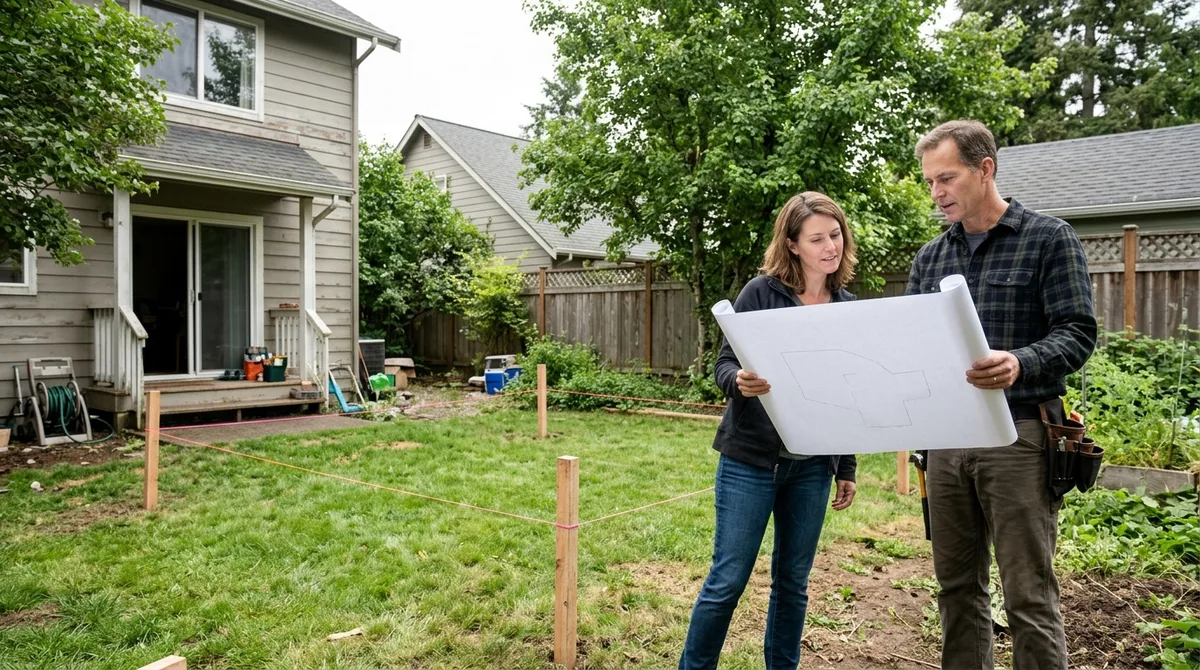
Before building, plan the ADU’s layout, guest operations, and project delivery together. This helps hosting work without undermining your household’s privacy or creating avoidable friction with neighbors.
Use the following decisions to connect the guest experience with your day-to-day life:
- Plan a guest entrance and route that keep visitors separate from the main home, and consider window placement to protect privacy for guests and household members.
- Decide how outdoor space, waste handling, and parking will work for guests without disrupting your household or nearby residents.
- Address sound control in the layout and construction plan, especially where the ADU shares a wall or sits close to the main home or neighboring properties.
- Choose who will handle guest communication, check-in, cleaning, linen changes, restocking, maintenance, and problem-solving: you or someone you arrange to help.
- When comparing contractors, ask how they will address access, privacy, parking, and noise control in the project plan.
The operating plan matters as much as the floor plan. Frequent turnovers can mean repeated cleaning and linen changes, while guest questions or maintenance issues may arise when you are busy or away. Decide how you will keep the unit ready and respond promptly before committing to a hosting model.
All County Development reports more than 20 years of experience. That experience can help connect your intended guest experience with practical site and layout decisions for an ADU or garage conversion.
The company website reports 90+ successful projects, 90+ satisfied clients, 90+ dedicated experts, and $1.4 million saved by clients. If you are assessing an ADU or garage conversion, ask All County Development about a free consultation or estimate to discuss your hosting priorities and project plan.
Map Your ADU’s Next Steps
Before pricing an ADU around vacation bookings, send the exact property address to the planning department for its jurisdiction. If the home is in Tarzana, Sherman Oaks, Encino, Woodland Hills, Calabasas, West Hollywood, Beverly Hills, Santa Monica, or Northridge, do not rely on the city name alone. Ask which agency governs the parcel and whether the existing or proposed unit may be rented for stays of 30 days or less.
Include the ADU’s permit or Certificate of Occupancy information, if available, and explain whether you plan to host in the ADU or another unit. Ask the agency to identify any required registration and the documents needed to establish the unit’s legal status. Keep the response with your project records before including short-term income in a construction budget.
Once you have that answer, discuss the site and project scope with All County Development. A conversation can help you assess how a permitted rental plan fits the property’s layout and construction priorities. Call (818) 815-7390 or visit 6117 Reseda Blvd, Tarzana, CA 91335 to discuss your next step.
Frequently Asked Questions
1. What documents should you gather before asking the city whether your ADU can be used for Home-Sharing?
Gather the property address, parcel number if available, ADU building-permit records, any Certificate of Occupancy, and approved plans that identify the unit. Briefly describe which unit you plan to host and the stay length you are considering, then ask the agency with jurisdiction to confirm what additional records it needs.
2. How should you account for seasonal demand when estimating an ADU’s hosting income?
Estimate demand month by month instead of applying one annual occupancy or nightly rate to every season. Compare similar nearby listings and account for changes in expected bookings and rates. Then model conservative, typical, and stronger-demand scenarios alongside operating costs.
3. Can you stop your neighbor from having an Airbnb?
You can report a concern, but whether a neighbor’s hosting is allowed depends on the parcel’s jurisdiction and applicable rules. Save the listing details and dates, note the specific impact you are experiencing, and contact the local agency responsible for the property rather than assuming the listing is unlawful.